This is a photo of a game on my son’s laptop – spaceship sprites scattered across a blue nebula and asteroids drifting in patterns. My husband and I built this little universe for our son, with the help of AI.
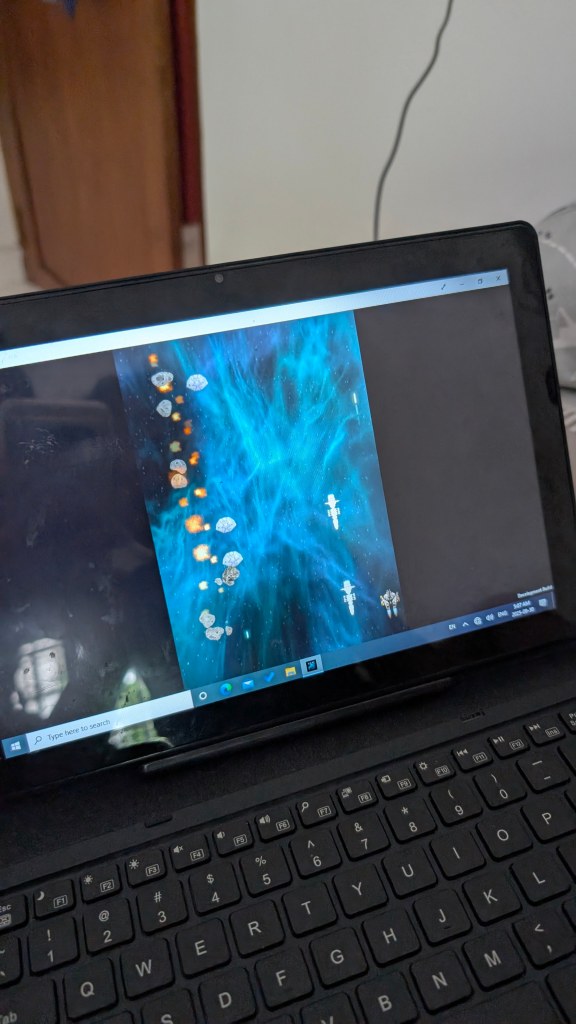
As I shared on my last post, Thinking in the Age of AI, I realized this is exactly the kind of example that shows how AI can be used meaningfully and responsibly.
We built this game, not because we’re developers (we’re not), and not because we had endless hours to spare (we definitely don’t). But because somewhere between the targeted ads and the auto-play suggestions and the content that sneaks into every corner of children’s games these days, we realized something fundamental: we couldn’t just hand him a screen and hope for the best.
As parents, we had a choice to make about what enters our child’s world.
The thing about modern parenting and screens
I remember when the concern was simply “too much screen time.” Now it’s so much more layered: What is the screen time? What’s hiding in the free games? What values are being whispered through the ads between levels? What worldview is being quietly built, choice by choice, click by click?
We’d tried the offline games, the ones downloaded with good intentions. But even those—especially those—came with ads. Bright, flashy interruptions selling things, ideas, emotions that felt jarringly out of sync with what we wanted our son to absorb. Not explicitly harmful, perhaps, but not aligned either. And alignment matters when you’re shaping a young mind.
The online games? A whole ecosystem we couldn’t control, couldn’t preview, couldn’t trust. Strangers in chat rooms. Algorithms designed for maximum engagement. Systems built to pull children deeper in, to keep them playing just one more round, earning just one more reward.
So we did what felt both unconventional and necessary: we built him his own game.
Building with intention
My husband and I aren’t coders. We’re just two parents who believe that intentionality matters. We believe that the small choices we make today shape the adults our children become tomorrow.
One evening, we pulled up an AI tool and started describing what we wanted: A spaceship. Some obstacles to navigate. Nothing frightening or violent. Bright colors. Simple controls. No ads. No tracking. No strangers. No hidden purchases. Just… a game. A wholesome space where our son could play without us worrying about what’s lurking in the background.
And remarkably, it worked. The AI translated our parental vision into something functional, something ours.
There was something deeply meaningful about it. Not in a “look what we accomplished” way, but in a “we built this small, protected corner for him” way. Like choosing what books line his shelf. Like being mindful of the stories we tell before bed. Like every other deliberate choice we make about what shapes his understanding of the world.
What we’re really building
The game itself is nothing revolutionary. It’s just asteroids and spaceships and little points accumulating in the corner. But what strikes me is what it doesn’t have.
It doesn’t have algorithms deciding what he should want next. It doesn’t have purchases disguised behind kid-friendly characters. It doesn’t have that creeping feeling that someone, somewhere, is collecting data on how long a child stares at a particular screen.
In creating something from scratch, we realized we weren’t just making a game. We were exercising our responsibility as parents to curate our child’s environment. We were saying: Not everything has to be optimized for engagement. Not everything needs to pull you deeper in. Sometimes, a game can just be a game—simple, contained, and intentionally limited.
This is what parenting in the digital age requires, I think. Not perfection, but intentionality. Not total control, but thoughtful curation.
Lessons beyond the screen
As I watched my son navigate his little spacecraft, I thought about how this connects to the kind of education, and the kind of life, we want to give him.
We live in a world that increasingly fragments our attention, that separates learning from meaning, entertainment from values, convenience from consequence. Everything is gamified, monetized, optimized. Children are growing up in environments designed by people who may not share our values, may not consider the long-term impact of their design choices.
But as parents, we have more agency than we sometimes realize. We can’t change the entire internet, but we can decide what enters our home. We can’t control every influence, but we can be deliberate about the primary influences during these formative years.
This little game became a reminder that small acts of resistance matter. Intentional choices accumulate. Every time we choose to create rather than consume, to curate rather than accept whatever’s offered, we’re teaching our children that we don’t have to accept things as they are simply because they’re convenient.
The heart of the matter
I think about the world my son is growing up in- how it’s so different from the one we knew as children. He’ll face challenges we can barely imagine, temptations we never encountered, choices that will come faster and more frequently than anything our generation experienced.
What he needs isn’t just protection, but a foundation. He needs to grow up understanding that not everything deserves his attention. That his time, his mind, his heart are precious. That there’s a difference between what’s easy and what’s good, between what’s entertaining and what’s enriching.
This game, in its own small way, is part of building that foundation. It’s a contained universe where he can play and explore without being pulled into systems designed to exploit his natural curiosity and tendency toward engagement.
It’s us saying: Your childhood matters. Your innocence matters. Your ability to play without being marketed to, to explore without being tracked, to simply be a child- all of this matters.
In the meantime
My son doesn’t know any of this, of course. He just knows there’s a game on the tablet where he flies a spaceship and dodges asteroids. He doesn’t know his parents spent an evening crafting it specifically for him. He doesn’t know about the ads we filtered out or the data we kept private.
Maybe one day we’ll tell him. Maybe he’ll roll his eyes at our over-protectiveness, the way we once rolled our eyes at our own parents’ rules about TV time and sugar cereals.
But for now, he’s piloting his little spacecraft across a blue nebula.
Because if we don’t make these choices deliberately, the world will make them for us. And as parents, that’s a responsibility we can’t delegate to algorithms or game developers, not even to well-meaning companies with mission statements about enriching children’s lives.
The greater purpose
I don’t know what the future holds for parenting in an increasingly digital world. I don’t know how long we can maintain these boundaries or what new challenges tomorrow will bring.
But I do know that the effort matters. The intention matters. Every time we pause to consider what we’re allowing into our children’s lives, every time we choose the harder path of creation over the easier path of consumption, we’re doing something meaningful.
We’re teaching them that they’re worth the effort. That their development deserves our attention. That there’s a different way to engage with technology. We don’t have to be passive consumers, but intentional creators and thoughtful participants.
Discover more from Najath Kareem
Subscribe to get the latest posts sent to your email.

 Najath Kareem